
Last Updated: October 22, 2026
Quick Summary
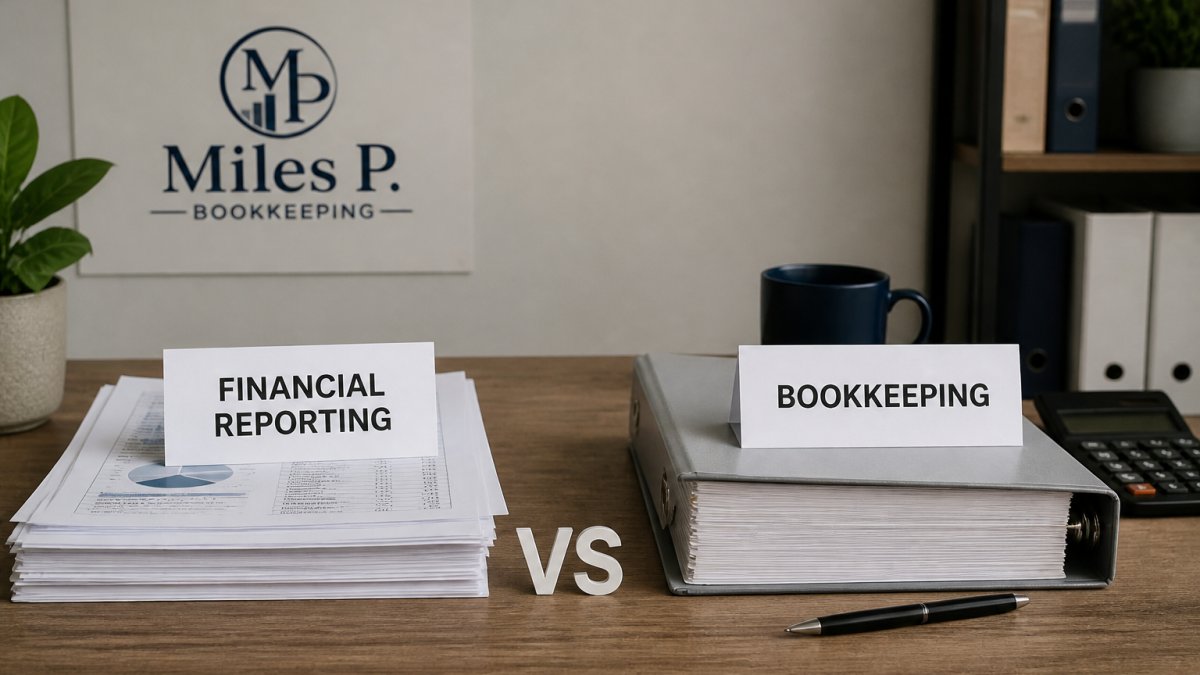
Financial reporting vs bookkeeping are distinct functions: bookkeeping is the systematic recording of every financial transaction into your accounting system, while financial reporting transforms that data into meaningful statements like the income statement, balance sheet, and cash flow statement to answer critical business questions. Bookkeeping creates the raw material; financial reporting analyzes it to support decision-making.
- Bookkeeping records transactions from receipts, invoices, and bank statements; financial reporting produces three core statements that reveal profitability, cash position, and financial trends.
- Accurate bookkeeping is the prerequisite for financial reporting: a single misclassified transaction can distort your income statement or balance sheet.
- Accrual-basis reporting matches revenue to its cost and is what most lenders expect, while cash-basis reporting tracks the bank account closely but can show timing distortion.
- The three core financial statements are the income statement (profit and loss), balance sheet (assets, liabilities, equity), and cash flow statement (how cash moved during a period).
- Professional bookkeeping becomes valuable when it takes more than 5-10 hours per month or when transaction volume and business complexity exceed your accounting knowledge.
Table of Contents
- Financial Reporting vs Bookkeeping: Core Differences
- How Bookkeeping Supports Financial Reporting
- Accrual Accounting vs Cash Basis: Impact on Your Reports
- Small Business Financial Statement Examples and When to Use Them
- Importance of Financial Reporting for Business Growth
- Common Errors and Their Impact on Reporting
- When to Hire Professional Help for Bookkeeping and Reporting
- Frequently Asked Questions
Financial Reporting vs Bookkeeping: Core Differences
Understanding financial reporting vs bookkeeping is essential for small business owners. The terms are often used interchangeably, but they’re distinct functions that work together to give you a complete financial picture.
What Bookkeeping Does
Bookkeeping is the systematic recording of every financial transaction your business makes. A bookkeeper captures data from source documents like receipts, invoices, bills, and bank statements and enters them into your accounting system.
Core responsibilities include recording debits and credits in a general ledger, categorizing transactions, reconciling bank statements, and tracking accounts payable and receivable. Bookkeeping creates the raw material everything else depends on.
The biggest mistake small business owners make is treating bookkeeping as optional until tax time. Accurate, current records let you understand your cash position and profitability in real time, not months later when your accountant files your return.
What Financial Reporting Does
Financial reporting transforms bookkeeping data into meaningful statements and summaries, answering critical questions: Are we profitable? Do we have enough cash? How does our financial position compare to last month?
Financial reporting produces the three core statements: the income statement (profit and loss), the balance sheet, and the cash flow statement. These reports help you understand performance, identify trends, and make decisions about growth, spending, and strategy, it’s where bookkeeping data becomes actionable business intelligence.
How Bookkeeping Supports Financial Reporting
Bookkeeping is the prerequisite for financial reporting: you cannot produce accurate financial statements without accurate underlying transaction data.
Accuracy matters in the bookkeeping phase: a single misclassified transaction can distort your income statement or balance sheet, and a missed bank reconciliation can hide cash flow problems.

Many small business owners skip monthly bookkeeping and catch up quarterly or before tax time.
Accrual Accounting vs Cash Basis: Impact on Your Reports
The accounting method you choose changes how bookkeeping records transactions and how financial reports present your position, the numbers a lender, tax preparer, or owner sees.
Cash Basis Bookkeeping and Reporting
Cash basis records transactions only when money moves: revenue when a customer pays, expenses when you pay a bill. It’s simpler and tracks the bank account closely, which many owners find intuitive.
The trade-off is timing distortion. Suppose you invoice a customer $10,000 in December, they pay in January, and you receive a $6,000 supplier invoice in December but pay it in January.
Accrual Basis Bookkeeping and Reporting
Accrual basis records transactions when they occur, regardless of cash movement: revenue when you invoice, expenses when you incur them. In the same example, December shows $10,000 of revenue and $6,000 of expense, and January shows the cash collection and payment.
The cost is more bookkeeping work: you track accounts receivable, accounts payable, accrued expenses, deferred revenue, and adjusting entries at each close. That work is what makes the reports reliable.
How the Basis Changes Your Reports
The same month can look very different under the two methods. A growing business that invoices ahead of collection often shows higher revenue and profit on an accrual income statement, while its cash flow statement explains why cash lags. A business with heavy prepaid expenses or inventory can show lower near-term profit on accrual because costs are matched to the period they benefit.
The balance sheet is affected too: cash basis records often show little or no accounts receivable or payable, understating what customers owe you and what you owe suppliers, which matters when a lender evaluates liquidity.
Reporting Requirements and Basis Differences
Different users can require different bases, and small businesses commonly keep one set of books and present reports on more than one basis:
- Tax reporting: Many small businesses file on the cash method, and the IRS generally permits it for eligible small business taxpayers, though inventory and entity type can affect eligibility. Confirm the rules that apply to your situation with a tax professional.
- Lender and investor reporting: Lenders frequently request accrual-basis or CPA-reviewed statements, particularly for larger loans or lines of credit.
- Management reporting: Owners often want both a cash view for cash planning and an accrual view for profitability, which is why the cash flow statement exists alongside the income statement.
A practical approach: keep the books on the basis that best reflects the business, then produce a cash-basis or accrual-basis report for a specific audience. State the basis clearly on every report so no one compares numbers prepared on different methods.
Never mix bases within one report or compare an accrual month to a cash-basis month without adjusting. The result looks like a trend but is actually a change in method.
For most small businesses, accrual-basis reporting gives better insight into true profitability, while cash-basis reporting remains useful for cash planning and often tax filing. The right answer depends on entity type, revenue, inventory, and who reads the statements.
Small Business Financial Statement Examples and When to Use Them
Three core financial statements form the foundation of financial reporting for any small business. The difference between a useful report and a decorative one is whether you can tie each statement to a specific decision. Here’s how each works, with an example and the decision it should drive.
Income Statement (Profit & Loss)
The income statement shows revenue, expenses, and net income over a period. It answers: did we make money?
A typical layout lists revenue, subtracts cost of goods sold to show gross profit, subtracts operating expenses to show operating income, then subtracts interest and taxes to show net income.
Use the income statement monthly to test pricing, compare product-line or service-line profitability, and spot expense creep.
Balance Sheet
The balance sheet shows assets, liabilities, and equity at a point in time. It answers: what is the business worth, and what does it owe?
Assets include cash, accounts receivable, inventory, and fixed assets such as equipment; liabilities include accounts payable, credit cards, loans, and sales tax payable; equity is assets minus liabilities.
Use the balance sheet quarterly and before any financing application.
Cash Flow Statement
The cash flow statement shows how cash moved during a period and reconciles net income to the change in cash.
It separates operating cash flow (normal business activity), investing cash flow (equipment purchases or sales), and financing cash flow (loans, owner contributions, distributions).
Use the cash flow statement monthly, especially with seasonal revenue or inventory. It is the statement that prevents a profitable business from running out of cash.
Reporting Cadence and the Monthly Close
Reliable reporting depends on a repeatable close process. A practical small-business cadence looks like this:
- Daily or weekly: record sales, invoices, bills, and receipts; code transactions to the right accounts.
- Monthly: reconcile every bank and credit card account, review uncategorized transactions, record adjusting entries for accruals, prepaids, depreciation, and inventory, then produce the three statements.
- Quarterly: review the balance sheet, compare actuals to budget, and check sales tax and payroll filings.
In a small business, the bookkeeper prepares the records and initial close, the owner or manager reviews the statements, and a CPA reviews or compiles them when a lender, investor, or tax preparer needs formal reporting. Separating preparation from review catches errors before they reach a decision-maker.
Ask for the same three statements every month, in the same format, with a short comparison to the prior month and the same month last year. Consistency makes trends visible; a different format each month hides them.
Importance of Financial Reporting for Business Growth
Accurate financial reporting is not just for compliance. It’s your primary tool for understanding your business and making growth decisions.
Many business owners operate without regular financial reports, relying on intuition about profitability and cash.
Financial reporting also reveals inefficiencies, a product line dragging down profitability, an unsustainable customer acquisition cost in one channel, a cash conversion cycle that’s too long.
For growing businesses, financial reporting becomes essential: as complexity increases, intuition becomes unreliable.
The businesses that scale fastest are the ones that make decisions based on current financial data, not guesses. Monthly financial reporting gives you that advantage.
Common Errors and Their Impact on Reporting
Small business bookkeeping mistakes compound. A single error in transaction recording or categorization can distort your financial statements and lead to poor decisions or tax problems.
Common errors include misclassifying transactions (recording a capital purchase as an expense, or vice versa), failing to reconcile accounts regularly, mixing personal and business transactions, forgetting to record transactions entirely, and failing to account for accrued expenses or deferred revenue.
This is where professional bookkeeping support becomes valuable: a bookkeeper with industry experience knows which errors are common and catches mistakes before they propagate through your financial statements.
When to Hire Professional Help for Bookkeeping and Reporting
For service businesses, contractors, and e-commerce operations, professional bookkeeping becomes essential quickly: these models have higher transaction volumes, more complex revenue recognition, and often require job costing or inventory tracking that demands specialized knowledge.
MilesP Bookkeeping works with small business owners across retail, e-commerce, construction, and service industries on monthly bookkeeping, bank and credit-card reconciliation, payroll support, and custom financial reporting.
Base the decision on two factors: your time cost (what else could you do with those hours?) and the risk of errors (what would mistakes cost you?). For most growing small businesses, professional bookkeeping pays for itself through better decisions and reduced stress.
Accurate bookkeeping and regular financial reporting are foundational to running a business you understand and can scale confidently. Bookkeeping creates the data, and financial reporting transforms it into actionable insights.
| Task | Bookkeeping | Financial Reporting |
|---|---|---|
| Primary Focus | Record transactions accurately | Analyze and interpret financial data |
| Timing | Ongoing, transaction-by-transaction | Periodic (monthly, quarterly, annually) |
| Output | General ledger, transaction records | Financial statements, reports, analysis |
| Purpose | Create reliable source data | Support decision-making and compliance |
| Audience | Internal (owner, accountant) | Internal and external (lenders, investors, tax authorities) |
| Frequency Review | Weekly or monthly | Monthly, quarterly, or annually |
Frequently Asked Questions
What is the difference between bookkeeping and financial reporting?
Bookkeeping records every financial transaction, sales, expenses, payroll, bank deposits, in a systematic way using debits and credits. Financial reporting takes that recorded data and organizes it into statements like profit and loss, balance sheets, and cash flow reports. Bookkeeping is the foundation; financial reporting interprets what those records mean for your business decisions.
Should a small business use accrual accounting vs cash basis?
Cash basis is simpler: you record income when cash arrives and expenses when you pay them. Accrual basis records income when earned and expenses when incurred, regardless of payment timing. Most small businesses with inventory, employees, or credit customers benefit from accrual basis because it shows true profitability. Your accountant can advise based on your industry and tax situation.
What financial statements does a small business actually need to review?
Every small business should review three core statements monthly: the income statement (profit and loss), which shows revenue minus expenses; the balance sheet, which lists assets, liabilities, and equity; and the cash flow statement, which tracks money in and out. These three reports tell you profitability, financial position, and whether you have cash to pay bills and grow.
When should a small business hire professional bookkeeping and financial reporting help?
Consider professional help when bookkeeping takes more than 5-10 hours per week, you have multiple income streams or employees, your QuickBooks files are disorganized, or you’re unsure if your records are tax-compliant. Professional bookkeepers catch errors before tax time, ensure payroll compliance, and deliver accurate reports that guide better decisions. Many small businesses find this pays for itself through tax savings and smarter operations.
